New Multi-Omics Study Reveals Time-Dependent Endothelial Responses to Far-Infrared Therapy
A new study published in Cells has provided further insight into the molecular responses of arterial endothelial cells following far-infrared (FIR) irradiation.
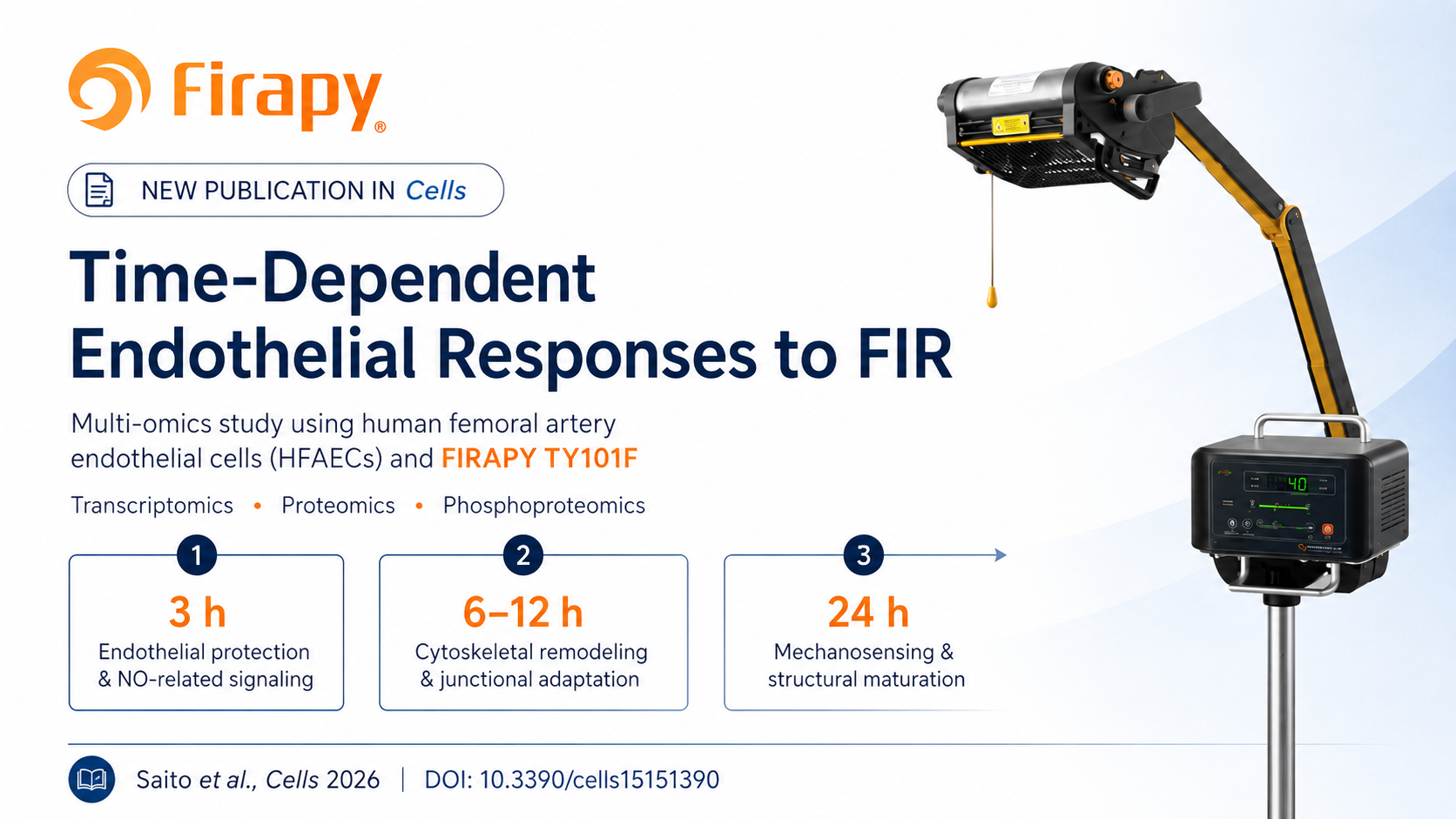
The study, conducted by researchers from Gunma Paz University, Japan, investigated the effects of FIR on human femoral artery endothelial cells (HFAECs) using an integrated multi-omics approach combining transcriptomics, proteomics, and phosphoproteomics. FIR irradiation was delivered using the WSTM TY101F far-infrared therapy unit manufactured by WS Far Infrared Medical Technology.
Why This Study Matters
Far-infrared therapy has been studied clinically in areas including vascular access care in hemodialysis patients. However, the molecular responses induced by FIR in adult arterial endothelial cells have remained incompletely understood.
Unlike many previous endothelial studies that used human umbilical vein endothelial cells, this study focused on human femoral artery endothelial cells, which more closely represent adult arterial endothelial biology and are relevant to vascular homeostasis, mechanosensing, endothelial barrier integrity, and vascular remodeling.
A Time-Dependent Molecular Response
The researchers observed that FIR irradiation induced a coordinated and time-dependent molecular response.
At the transcriptional level, 424 differentially expressed genes were identified three hours after FIR exposure. These included genes associated with endothelial protection, nitric oxide regulation, oxidative-stress responses, and cellular stress adaptation, including KLF2, NOS3, and HMOX1.
Proteomic and phosphoproteomic analyses further showed that the endothelial response continued to evolve over time.
At approximately 6 hours, molecular changes were associated with cytoskeletal remodeling, vascular maturation-related signaling, and nitric oxide-related regulation.
By 12 hours, the response had expanded to include cell polarity, junctional remodeling, calcium/nitric oxide-related regulation, and adaptive cellular processes.
At 24 hours, the study identified changes associated with mechanosensing, focal adhesion remodeling, cytoskeletal organization, and structural adaptation, including a Rho GTPase-related phosphorylation network involving key proteins such as CAV1, CTNNB1, and LMNB1.
Adding a New Layer to FIR Research
Taken together, the findings suggest that FIR does not trigger only a single molecular pathway. Instead, it appears to induce a sequential endothelial response, progressing from early protective and nitric oxide-related signaling toward structural remodeling and mechanotransduction.
This study adds an important mechanistic layer to the growing body of FIR research and may help improve our understanding of the biological responses associated with FIR therapy.
The authors also emphasize that these findings are hypothesis-generating. Further functional studies are required to determine whether the observed molecular changes translate directly into improved endothelial function or vascular repair.
Publication Information
Saito M, Kimura A, Hanada S, Hayashi Y, Kimura H.
Far-Infrared Irradiation Induces Time-Dependent Endothelial-Protective and Vascular Repair-Associated Molecular Remodeling in Human Femoral Artery Endothelial Cells.
Cells. 2026;15:1390.
FIRAPY continues to support scientific research aimed at further understanding the biological mechanisms and clinical potential of far-infrared therapy.
Want to know more?
Contact us for more detail